Part of a Global Network
The India Humanitarian Hub is the India country hub of Start Network, a global network of more than 160 local, national and international organisations with a presence across more than 160 countries. Start Network was established in 2010 to shift humanitarian action from reactive aid towards a system that is risk informed and driven by frontline organisations. More than three quarters of its membership are local and national organisations.
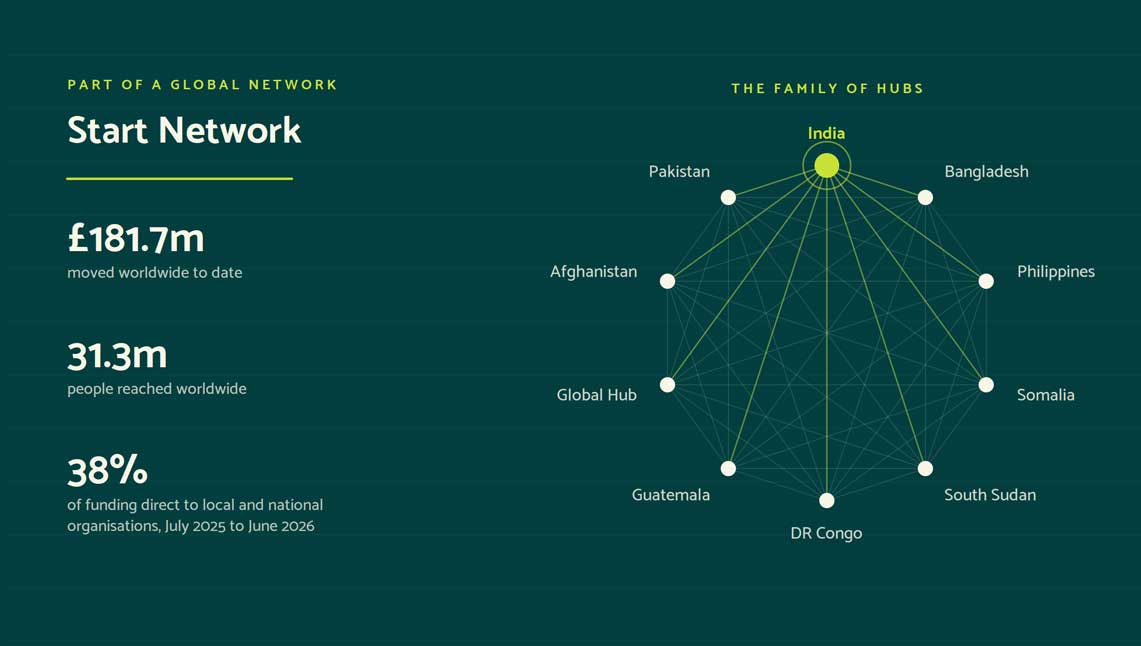
£181.7 million
moved worldwide to date
31.3 million
people reached worldwide
38%
of funding direct to local and national organisations, July 2025 to June 2026
What a hub is
Start Network hubs are collectives of local, national and international organisations or humanitarian responders operating in the same country or region. Hubs come together through a vision of system change, to tackle the deep-rooted issues in humanitarian responses within their countries. They control their own resources and define their own responses to crises affecting their communities. They are supported by the global Start Network.
The Wider Family of Hubs
India sits alongside ten other country hubs, each shaped by its own context.
Afghanistan. A locally led network of humanitarian organisations, social-impact businesses and academics working to strengthen community resilience to disasters and displacement. Promotes community-led preparedness, response and recovery through collaborative and locally driven approaches, such as Community Response Clinics that support local action during emergencies. The Hub works with communities to strengthen local capacity to prepare for, respond to and recover from crises.
Bangladesh. A 40-member network advancing locally led humanitarian action and community-driven leadership. Supports rapid response, anticipatory action and community-led innovation through initiatives including Start Fund Bangladesh, FOREWARN and disaster risk financing. The Hub has pioneered the NGO-MFI Resourced Pool Fund, a locally owned financing mechanism that uses microfinance surpluses to create a pre-positioned fund for emergency response, helping reduce dependence on traditional aid funding.
Democratic Republic of the Congo. A locally led platform bringing together national and international organisations to strengthen humanitarian coordination, funding access and community-centred response. Supports preparedness, response and recovery in areas affected by conflict and climate shocks, including through the TUBAKI IMARA Community Recovery Fund, a locally led resilience and recovery financing mechanism. The Hub works to expand direct access to funding for local actors and strengthen collective humanitarian action.
Guatemala. A network of local, national and international organisations working to transform humanitarian action through community empowerment, local leadership and intercultural approaches. Supports anticipatory action, resilience and community-led innovation by building on the priorities, knowledge and capacities of local and Indigenous communities. The Hub is helping to develop, test and scale locally designed solutions to humanitarian challenges.
Pakistan. Known as READY Pakistan, a network of 51 local, national and international organisations working to strengthen anticipatory action, disaster preparedness and community resilience. A national leader in disaster risk financing, it developed Pakistan’s disaster risk financing model and has helped protect more than 15 million people through anticipatory action mechanisms. The Hub supports locally led responses to climate-related risks, including floods, droughts and extreme heat.
Philippines. A locally led platform advancing humanitarian, resilience, peace and development action across the Philippines. In a country highly exposed to climate-related disasters and shaped by a dispersed island geography, the Hub works through a network of 18 regional hubs that bring leadership and decision-making closer to affected communities. Built on decades of community-led action, it strengthens humanitarian systems grounded in local knowledge, collaboration and anticipatory approaches.
Somalia. A locally led network of humanitarian organisations working to strengthen crisis response, anticipatory action and community resilience in a context shaped by recurrent droughts and floods. Combines Indigenous knowledge with innovation and data-driven approaches to support community-centred preparedness and early action. The Hub is advancing locally led funding mechanisms, including plans for a Somali-managed pooled fund to support timely humanitarian action.
South Sudan. An umbrella network of local, national and international organisations working to shift power and resources to local actors within the humanitarian system. Established through the leadership of South Sudanese women-led organisations, the Hub continues to champion inclusive leadership and ensure the voices, priorities and experiences of women are reflected in humanitarian action. It promotes anticipatory action, locally led advocacy and improved access to humanitarian funding while strengthening community-led approaches that place affected people at the centre of decision-making.
Global Hub. Established to bring together Start Network members based outside hub countries, the Global Hub provides a route for organisations to engage in the Network of Networks and help shape its future governance. Members are currently developing the Hub’s vision, value proposition and interim governance arrangements through a collaborative process. The Hub aims to strengthen collaboration, peer learning and collective action across organisations working in more than 120 countries.
To find out more about Start Network Hubs, please visit our website here.