
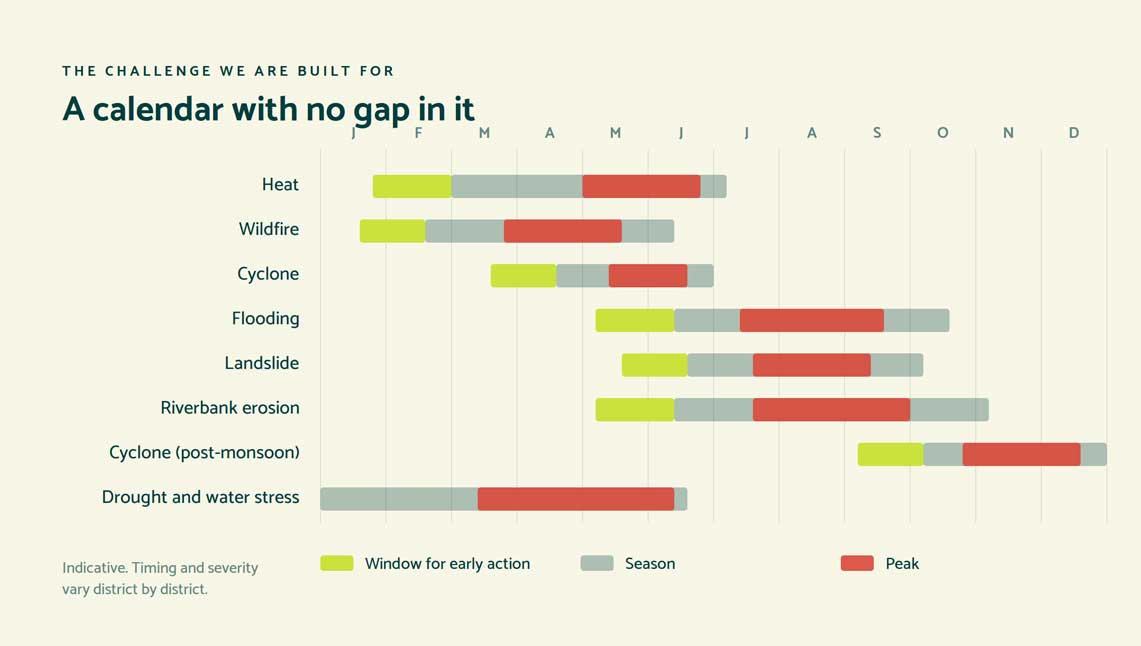
The challenge we are built for
India’s humanitarian picture is shaped by climate. Floods, cyclones, heatwaves, drought, landslides, storms and riverbank erosion arrive more often and land harder, and they land on communities whose exposure has not fallen at the same rate as the country’s growth.
Our members read the problem in two parts.
Action on climate risk in India is largely reactive and under resourced, and it does not draw enough on the analysis, capacity and practical innovation that Indian civil society already holds.
The scale of humanitarian need is not always recognised and the most vulnerable districts are not always prioritised. Effort converges in the same places, methods of delivery have not kept pace, and the people closest to a crisis are too often absent from the conversations that matter.
Across hazards, not one
Our members have responded to flooding, cyclone, storm, landslide, wildfire, riverbank erosion, fire and displacement, and are working on heat, drought and slow onset water stress. Which risk is prioritised depends on the district and the season.
Where our members are focusing
Anticipatory action and preparedness. Moving from response after the event to risk informed action before it, and strengthening the readiness of communities and institutions alike.
Innovation and evidence. Testing locally designed solutions, generating the evidence that shows whether they work, drawing on indigenous and community knowledge, and scaling what proves itself.
Capacity strengthening. Peer learning and exchange across the membership, so that what one organisation learned the hard way does not have to be learned again by the next. This is the area most of our members are actively working on and the area they find hardest to fund, which makes it one of the clearest gaps the Hub is built to close.
Financing. Widening the base of humanitarian finance in India, and testing financing that is risk informed rather than reactive.
Convening and partnership. Strengthening partnership with government, and holding the space where civil society, academia, the private sector and communities meet.