The India Humanitarian Hub is not another implementing organisation. It is the platform through which various organisations act as one.
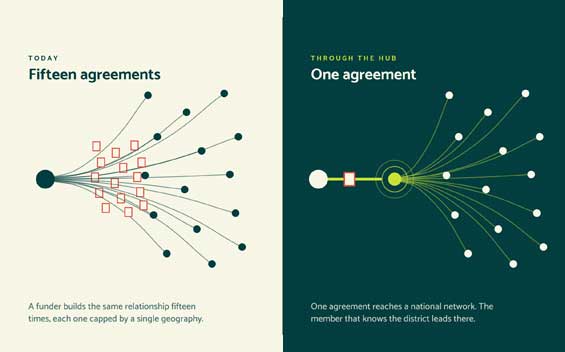
India does not lack capable humanitarian organisations. What it lacks is a way for them to work as a system. Funders end up building the same relationship fifteen times over, each one limited to the geography and the specialism of a single organisation. Communities in the districts nobody has a partner in wait. And the practical knowledge held by organisations that have worked the same floodplain for forty years rarely travels beyond it.
The Hub exists to close that gap. One agreement reaches a national network. The organisation that knows the district leads the work in that district. The organisation that has built the method shares it with the others. Founded on March 19, 2019, owned by its members and governed by an Executive Committee they elect, the Hub sets its priorities through its membership rather than for it.
Technology that finds the household at risk.
SEEDS built Sunny Lives with Microsoft’s AI for Good Lab, a model that scores heat and cyclone risk building by building from satellite imagery and roof material, and has used it across settlements in Delhi and Nagpur. It also built Akshvi, a disaster e-wallet that lets affected households record their own loss and damage and puts a value against it, seed funded by the India Climate Collaborative and first used after Cyclone Biparjoy and the Himachal floods.
Inclusion built into humanitarian practice.
Aaina has worked on disability, women’s and children’s rights in Odisha since 1998, holds special consultative status with the United Nations Economic and Social Council, and was the first civil society organisation permitted to work in the Kandhamal relief camps.
Adaptation recognised on the world stage.
AJSA India won the Locally Led Adaptation Award 2025 at COP30 in Belem, in the women’s livelihoods category, chosen from 489 entries across 86 countries for its work with more than 5,500 tribal women in the drought prone district of Kalahandi in Odisha.
A global voice for locally led aid, based in India.
Humanitarian Aid International hosts the international secretariat of Charter for Change, sits in ALNAP, and built the Dashboard for Aid Transparency and Accountability to open up humanitarian funding data in India.
Four decades on the same floodplain.
NEADS has worked the Brahmaputra floodplain from Jorhat since 1985. In the 2026 floods it reached 20,000 families across Upper Assam and then launched a multi sector post disaster needs assessment across Sivasagar, Charaideo and Jorhat to shape recovery. It represented Assam’s flood affected communities at COP30 as a Start Network observer.
Reach across a whole state.
CYSD has worked in Odisha since 1982, reaches all thirty districts, and has been a leading organisation in disaster response and preparedness in the state since the 1999 super cyclone.
We convene. We bring members and partners around a shared plan, and we hold the standards and the governance that make collective work possible.
We build evidence. We test locally designed solutions with communities, document what happens, and make the learning available to the whole network and beyond it. Our innovation work is open to organisations outside our membership where they bring the better idea.
We connect. We work with government so that collective effort strengthens public systems rather than duplicating them, and we bring civil society, academia, the private sector and communities into the same room.
We strengthen each other. Capability that sits inside one member becomes available to all of them. Members exchange method and practice through peer learning, exchange visits and the general assembly, so that an approach proven on the Brahmaputra floodplain can be tried in coastal Odisha without starting from nothing. The organisation is stronger afterwards, not just the project.